

Steve Jobs Connected the Dots Backward. I Have Spent My Life Connecting Them Forward.
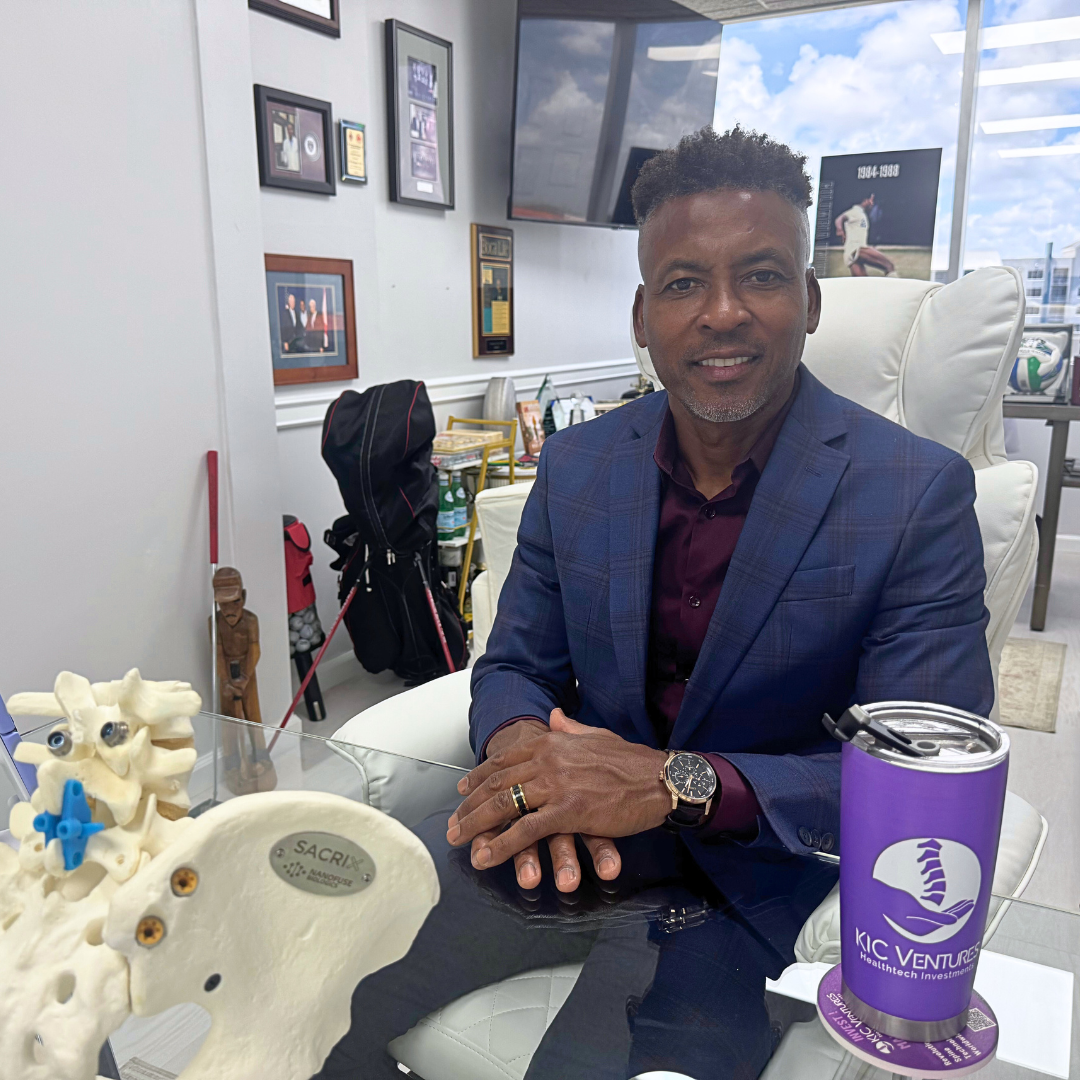
By Kingsley R. Chin, MD, MBA Founder, Chairman & CEO, KIC Ventures | HealthTech Investor | Orthopedic Spine Surgeon
August 25, 2026

Vision has always been the most important thing to me.
With vision, you do not have to follow trends. You can act before there is consensus. You do not buckle simply because circumstances become difficult. Pressure tests conviction. Obstacles force you to become more resourceful. Doubters teach you to become comfortable without validation.
Steve Jobs famously said that you can only connect the dots looking backward. I understand what he meant. Looking backward, the connections are easier to see.
But entrepreneurs, investors, inventors, physicians, and anyone trying to build something that does not yet exist face a different challenge:
Everyone can connect the dots backward. Visionaries have to connect them forward.
That has been the thread running through my life.
Seeing the Network Before Knowing Where It Would Lead
I joined LinkedIn in 2007, when professional networking online was still relatively early.
The platform was nothing like it is today, but I could see the value of a professional network unconstrained by geography, institutions, or the people you happened to know personally.
So I started connecting.
I did not know exactly where those connections would eventually lead. I simply believed that someone who wanted to build companies, find investors, collaborate with physicians and engineers, and connect ideas with capital would increasingly need a global professional network.
Nearly two decades later, that instinct has proven increasingly important.
For me, it has always been about connecting forward.
The First Dot
When I left Columbia University, I did not immediately go to medical school. I paused and joined Andersen Consulting, now Accenture, in Manhattan.
An assignment on Wall Street at Goldman Sachs helped crystallize a vision I could not yet fully execute: someday I wanted to build an investment firm.
But what would I know deeply enough to invest in?
I needed a foundation.
That became Harvard Medical School, orthopedic surgery, spine surgery, engineering, and ultimately years treating the very patients whose problems I wanted to solve.
By 2000, while at Harvard, I filed my first patent in spine surgery. That decision changed my trajectory.
I began seeing the surgeon not simply as a customer or consultant for medical technology companies, but as someone who could identify the problem, invent the solution, invest the capital, build the company, and participate in the value created.
MANTIS Taught Me That Innovation Could Create Value
In 2005, we sold the MANTIS Percutaneous Pedicle Screw System to Stryker.
That taught me how innovation becomes an asset and how an asset can create an exit.
It also taught me that selling one innovation was not the company I wanted to build.
I wanted to build an innovation machine.
One of our early surgeon investors told me, “Kingsley, I will only invest if we develop best-in-class products.”
I never forgot it.
We built SpineFrontier around innovation rather than copying existing products. Distribution was not initially the obsession. Building differentiated technologies was.
Move urgently on innovation. Be patient about when value is realized.
Connecting Beyond Fusion
By 2013, pedicle screws, cages, and cervical fusion dominated spine.
I could see another dot.
Rather than remain principally an operating spine company, we established KIC Ventures as an investment company and began transitioning away from the original SpineFrontier model.
In 2014, we acquired AxioMed.
The spine industry remained heavily committed to fusion and mechanical ball-and-socket artificial discs. We believed the future would increasingly favor motion preservation and viscoelastic disc replacement.
I invested millions of my own capital. Like-minded private investors, many of them surgeons, invested alongside me.
We were early.
Being early is not the same as being wrong.
It means you need enough conviction, capital discipline, and patience to survive until the conditions you anticipated begin to develop.
Another Dot: Regeneration
In 2018, we saw another transition developing in biologics.
We acquired a unique 45S5 bioactive glass formulation and created NanoFUSE Biologics around it.
Today, advances in bioactive glass are opening broader questions around regenerative therapeutics, cellular signaling, disc regeneration, vertebral bone pathology, antimicrobial applications, and drug delivery.
Again, the investment was made before the complete opportunity was obvious.
That is often what connecting forward looks like.
Another Dot: Interventional Spine
In 2019, we entered interventional pain management.
But that dot actually began much earlier.
We incorporated the LESS Society in 2007 around our LESS Exposure Spine Surgery philosophy, building on the tradition of minimally invasive spine surgery while asking whether spine care could move further toward earlier diagnosis, smaller interventions, and preservation of anatomy and motion.
That evolved into our REP principles:
Restore function. Early diagnosis and treatment. Preserve anatomy and motion.
Through NANISX, we began building an adjacent outpatient interventional spine market.
What initially looked like separate investments increasingly began to connect: NANISX for earlier outpatient intervention, NanoFUSE Biologics for regeneration, and AxioMed for motion preservation.
Together, they span a continuum from interventional pain management through spine surgery, regeneration, fusion when necessary, and disc replacement.
I could not have drawn every connection perfectly in 2007.
But the vision kept pointing in the same direction.
A Lecture That Captures How I Think
Several years ago, I gave a lecture at the Seattle Science Foundation on the history of innovation and business in spine surgery.
For spine surgeons and entrepreneurs who want to understand how technologies, companies, surgeons, capital, and market shifts have shaped this industry, I still think it is worth watching.
What matters to me about that lecture is not simply the history.
It reflects how I have always tried to think: study where an industry has been in order to anticipate where it may be going next.
Watch the lecture:
And Then There Is the Dot We Suspended
Not every forward connection should be commercialized immediately.
At CES Las Vegas in 2015, our SenseDriver automotive heads-up-display technology attracted significant attention. We met with major automobile and insurance companies around accident avoidance and automotive software.
We had choices: sell it, continue funding it aggressively, or preserve what we had built and wait.
We chose patience.
We suspended active development rather than surrender the technology simply because its immediate path was uncertain.
See what we demonstrated at CES in 2015:
Now AI is rapidly changing automobiles, sensing, prediction, human-machine interaction, and autonomous systems.
Was patience the right decision?
The answer will depend on what we do with the knowledge and technology from here.
Suspending something is not abandoning the vision.
Sometimes capital allocation requires recognizing that being early does not require spending as though the market has already arrived.
Vision Does Not Mean You Are Always Right
Connecting forward does not mean predicting everything correctly.
I have made mistakes.
Vision does not eliminate adversity. It gives adversity context.
When you know where you are trying to go, an obstacle becomes something to navigate rather than automatically a reason to turn around.
You learn.
You become more disciplined.
You develop thicker skin.
You stop requiring everyone around you to understand what you see.
And you become extraordinarily grateful for the relatively small number of people who do.
The 10%
Over the years, I have learned that perhaps 10% of the people you encounter genuinely want to build something with you.
They are rare.
The physician who invests because he understands the clinical problem.
The engineer who keeps working because the solution matters.
The investor who sees potential before the financial statements can prove it.
The entrepreneur whose vision makes me want to invest in theirs.
The collaborator who asks, “What can we build together?” rather than, “Why hasn’t someone already done this?”
Those relationships are among the most valuable assets I have accumulated.
They are also reminders that vision rarely becomes reality alone.
Connecting Forward
Looking backward now, I can connect many of the dots:
Columbia. Andersen Consulting. Goldman Sachs. Harvard Medical School. My first patent. MANTIS. KIC. SpineFrontier. The LESS Society. KIC Ventures. AxioMed. NanoFUSE Biologics. NANISX. Even SenseDriver.
But looking backward is the easy part.
The more important question is what dots we can connect forward from here.
The vision I had leaving Manhattan was not simply to become a surgeon or build a medical device company.
It was to build an investment firm capable of identifying important problems early, investing before the answers were obvious, building companies around those solutions, and creating lasting value for the people willing to invest and build alongside us.
Looking backward, I can see how the dots connected.
But I am far more interested in the dots that have not connected yet.
The next technology.
The next physician.
The next entrepreneur.
The next investor.
The next problem worth solving.
Everyone can connect the dots backward. The opportunity is learning to connect them forward.
Kingsley R. Chin, MD, MBA Founder, Chairman & CEOKIC Ventures


Comments