

The EBITDA of Care - Is Your Practice an Asset or Just a Job? The 2026 Shift from Service to Infrastructure.
- Anshul Jain

- Apr 29
- 2 min read
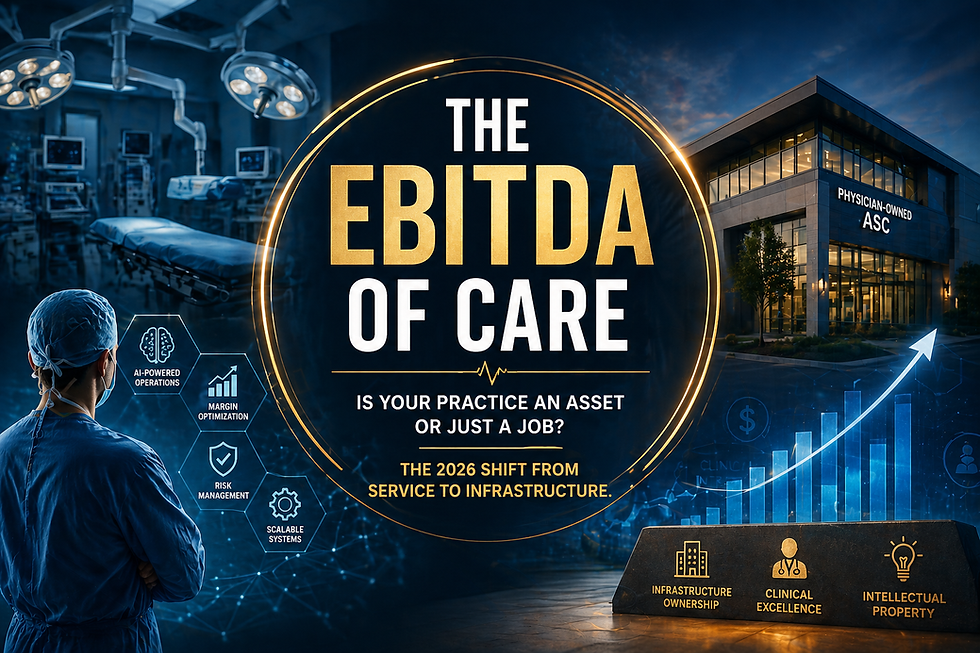
"If you were to step away from the OR for six months, would your clinical entity continue to build equity, or would the revenue stream flatline?"
In the professional landscape of 2026, many physicians are coming to a sobering realization: they don't own a business; they own a high-paying, high-stress job. While clinical volume is the engine of your current income, it is the infrastructure surrounding that volume that determines your ultimate exit value.
The shift from a labor-dependent service model to a scalable, institutional-grade asset is no longer optional. As private equity and hospital systems consolidate, the "Sovereign Surgeon" must pivot toward a Platform 3.0 model—where value is derived from operational efficiency and intellectual property rather than just personal surgical hours.
The Anatomy of a Scalable Clinical Asset
Labor vs. Systematized Infrastructure
Traditional practice valuation is often tethered to the "star producer." However, institutional buyers in 2026 are increasingly ignoring individual reputation in favor of reproducible, systematized EBITDA.
The Clinical Context: A practice that relies entirely on your physical presence to generate revenue is a service business. A scalable asset stems from proprietary clinical pathways and a facility that functions independently of any single provider.
The Strategic Takeaway: Service providers typically trade at a 3-4x multiple. Tech-enabled infrastructure platforms that prioritize systems over individual labor can command multiples of 8-12x.
The Margin Hedge: Agentic AI
Administrative bloat—specifically the friction of denials and prior-authorizations—is the single greatest eroder of clinical margin in the current market.
The Operational Filter: Are you still using human labor to fight insurance algorithms, or have you integrated Agentic AI to autonomously handle Revenue Cycle Management (RCM)?
The Financial Reality: Transitioning to autonomous administrative tech doesn't just reduce burnout; it directly inflates the EBITDA by lowering fixed costs, making your practice significantly more attractive to institutional capital.
The Vertical Integration Advantage
The "Outpatient Super-Cycle" has permanently moved the center of gravity for surgical wealth from the hospital to the physician-owned Ambulatory Surgery Center (ASC).
The Outcome Audit: Real wealth in 2026 is found in capturing the Facility Fee margin that physicians traditionally gift to hospital systems.
The Infrastructure Move: Owning the "Bricks and the Blades"—the equity in the facility and the intellectual property of the medical technology used within it—ensures that your capital builds wealth even when you are not in the operating room.
The Bottom Line: Ownership as the Ultimate Hedge
Uncertainty only breeds fear when your income is tied directly to your time. By shifting your focus from "service volume" to "infrastructure equity," you reclaim your professional autonomy.
Don't let your twenty-year legacy be summarized by a final paycheck. Build a platform that values your expertise as much as it values your time. Reclaim your financial vitals by investing in the systems you already power.
Financial Education Disclaimer: This article is for educational and informational purposes only and does not constitute financial, investment, or tax advice. DoctorpreneurNews is not a licensed fiduciary. Private equity and MedTech investments involve significant risk and illiquidity.


Comments